
It’s been over two months since my last post and I must admit, I’ve missed our weekly interactions about how insurance meets real life. Life has a way of pulling us in unexpected directions, but I’m truly glad to be back, reconnecting with you and bringing another story that hits close to home.
Today’s story comes from a not too long incident that reminds me that fire doesn’t just burn, sometimes it chokes. It also tests how well we prepare, insure, and respond.
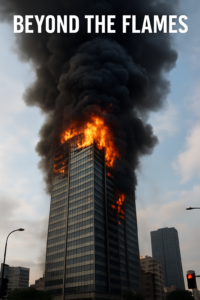
On 16 September 2025, at about 1:20 pm, fire broke out from the inverter room in the basement of Afriland Towers on Broad Street, Lagos. What began as an electrical fault quickly escalated through suffocating smoke that filled the building, severely limiting visibility and the use of evacuation routes. Tragically, lives were lost primarily due to smoke inhalation rather than the flames. Some occupants, in desperation, had to use windows to escape because the stairwells and exit routes were filled with smoke.
The fire was eventually extinguished, but the real damage wasn’t from the flames but from the smoke
Beyond the human loss and destruction, events like this force us to ask hard questions. How prepared are we for fire risks in our buildings, businesses, and public spaces? What role should insurance play? And even more critically, what responsibilities do we carry before and beyond buying a policy?
One of the most common misconceptions in the insurance world is that fire insurance only covers damages caused by flames. A comprehensive fire insurance policy often extends beyond fire to include:
- Smoke damage (as seen in Afriland Towers)
- Water damage from firefighting efforts
- Explosion caused by fire
- Riots and civil commotion, if endorsed
- Loss of rent or business interruption during repairs
And these are not just policy add-ons, they are central to the policy and recovery when disaster strikes in unexpected ways.
The Lesson Behind the Ashes
Let’s unpack how smoke damage fits into fire insurance coverage, why prevention matters, and what every business owner should learn from Afriland experience.
Because at the end of the day, insurance isn’t just about compensation, it’s about preparation.
Understanding Smoke Damage in Fire Insurance Policies
Does smoke damage count as fire damage?
In principle, a standard fire insurance policy covers loss or damage directly caused by fire and in most modern policies, smoke damage is included if it results from a sudden, accidental fire.
But here’s where many insureds get caught off guard. Some older or basic policies define “fire damage” narrowly focusing on destruction caused by actual flames, not the by-products like smoke, or corrosive fumes.
In the Afriland fire incident, can the smoke that spread into areas untouched by flames be classified as direct fire damage and therefore be recoverable under a standard fire insurance policy? The answer is Yes, even if the flames did not physically reach certain areas, the smoke that infiltrated, contaminated, or damaged those spaces is typically treated as part of the overall fire loss. However, coverage depends on the specific wording of the policy.
Risk Improvement Measures That Could Have Saved the Day
The Afriland incident also exposes another truth: insurance should be the last line of defence, not the first. Prevention and preparedness go a long way in reducing both the physical and financial scars of a fire event.
Here are key risk improvement measures that could have changed the outcome for both Afriland and its insurer:
- Regular Electrical and Equipment Inspections
The fire started from an electrical fault that could have been detected during a routine inspection. Scheduled maintenance, especially in high-load buildings, is not optional. It is essential.
- Effective Smoke Detection and Early Warning Systems
While fire alarms detected heat and flame, smoke detectors could have triggered an earlier response, potentially limiting spread and contamination. If you smell smoke or detect early signs of fire, evacuate immediately. Time is critical. In Afriland’s case the fire started at approx.1:20 pm and responders arrived approx. 20 minutes later. Avoid waiting until flames are visible; smoke inhalation kills faster than burns, as was the case here.
- Zoned Ventilation and Smoke Control Systems
In many modern buildings, smoke spread is controlled by zoning air ducts. Afriland’s open duct system allowed smoke to travel through multiple floors, amplifying the loss.
- Proper Documentation and Policy Review
Many businesses buy fire insurance once and forget about it. Annual policy reviews help ensure coverage reflects current risks, and that risks like smoke damage, business interruption, contents and relocation cover are explicitly covered.
- Employee Fire Safety Training
Staff should know how to act fast, shutting down power, using extinguishers, and reporting incidents. A few trained actions in those first minutes can prevent a full-blown disaster.
- Controlled Evacuation Routes
Verify that your building evacuation routes remain usable under heavy smoke. Train staff in evacuation under reduced visibility and plan how to evacuate when normal routes fail (windows, alternate stairwells).
- After the incident
- Notify your insurer promptly, document all damage (including smoke damage and loss of use).
- Keep all correspondence and records, especially if business interruption or contents loss is to be claimed.
- Cooperate with investigations
- Review and update your policy and risk mitigation measures.
The Big Takeaway
The Afriland fire incident shows clearly that fire insurance is not just about flames. When smoke spreads unchecked, losses can still be vast. The insured must take active steps to reduce risks, while the insurer must design robust policies that reflect modern realities of loss.
Smoke may be invisible at first, but its impact can be a massive disaster. It corrodes, contaminates, confuses, kills and if your policy isn’t clear about it, it could cost you dearly.
So, as you review your fire insurance policy, ask yourself: If smoke spreads, will my insurance coverage still stand strong?

Thanks for the beautiful write up.
The unfortunate incident of Afriland building makes one wonder if it will not be a good idea for insurers to be involved in public building design and probably at a stage in construction. At least to give professional advice on the need for adequate ventilation and provision of multiple escape routes
in situations of smoke or fire incidents.
This may be good in alleviating sad incidents of being in infernoes, smokes etc. and also compliments the professional efforts of architects and engineers.
My humble submission.